Making Innovation Work,
The Ten Faces of Innovation,
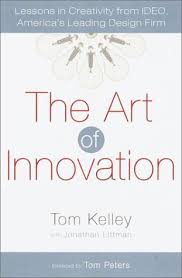
The Art of Innovation,
The Medici Effect,
CATS The Nine Lives of Innovation,
The Innovative Leader,
The Innovation Killer,
Exploiting Chaos




 exploiting chaos by jeremy gutsche
  Cynthia Baron Rabe in her book "Innovation Killer" is speaking about Groupthink as:
  So, here's the first chapter of my what-will-be book "I have the idea, and what now?"
 The term innovation can be heard in recent times from every direction. TV, newspapers, adds – everywhere we can see the word 'innovation' connected with wide range of products, from commercials for cosmetic products, to banking services. Politicians, professors, businessman or journalists – everyone have something to say about innovations. The term is used so much that there is the danger for it, to lose it's real meaning, and to make people take their look away from it.
Looking to origin, the word innovation is coming from latin in+novare with the meaning 'make something new'.
There are lots of definitions of innovation, I will start with the simplest one:
innovation is new idea the brings the profit.
In other words, that is the conversion of knowledge to money.
Innovations can also be defined with inventions which were converted to market products.
„Innovation distinguish leaders from followers.“
Steve Jobs
Innovation can be defined with only creating something new, but it we want complete definition, market factor must not be avoided.
We can define innovation also with something what isn't innovation: innovation isn't an invention. Many innovations don't use new technologies. In example, McDonalds hasn't spread their fast food concept with using latest technologies, but with managing restaurants in a new way.
It's not correct to think that innovation is something what people in „white suits“ are making in their laboratories.
Difference between innovation and invention can be defined in following way: Invention is first emergence of idea, but innovation is the first attempt to make it. Innovation then can be the usage of existing invention.
Innovation is not only the production of new products, but also the way of doing certain things and how to make it better.
In the case when invention improves some product, or service, or process, we can say that invention is transferred to innovation.
Innovation can be small or big, simple or complex. We can talk about innovation with disruptive idea, but also when just small changes are done on existing product, which must at least be measurable.
Biggest obstacles to innovations in the shape of some organizations are companies culture and management. Company must cultivate the culture that accepts new ideas from employees.
“Innovation has nothing to do with how many R&D dollars you have. When Apple came up with the Mac, IBM was spending at least 100 times more on R&D. It's not about money. It's about the people you have, how you're led, and how much you get it.”
Steve Jobs
The role of today's „knowledge economy“ is more important, so rich countries can't compete with low-cost products and services if they don't innovate faster and better.
Innovation is application of knowledge on the problem which occurs, and putting ideas to market. There is different situation with invention or discovery, where customer is not in inventors thoughts. Focus is clearly on invention. During innovation process, customer is the key factor, because innovation must have a market.
The way to submit idea becomes more easy and global as it will shown on the example of open innovations. This opening of innovative potentiality which is not reserved only to technological giants, opens new possibilities for solving current (and future) problems in the world.
IBM's research from 2006. based on answers from 765 interviews with leaders of organizations had the interesting answer on the question, which are the most significant origins of innovative ideas? Over 40% place employees as the most significant origin, only few percent less were business partners and customers.
This answer gives the significance to ideas which comes from employees, which are equally important, maybe even more important then ideas coming from customers.
At innovation, new product brings up new value to customer, with reducing of costs, gives improvement in relation with competitors, or contribute to end-customer satisfaction, or allows the increasing of sales with using new technologies or processes.
Finally, it most important, when customer says that it's an innovation.
Looking through the source of ideas, inventions comes from inventors effort and it can turn up in experiments, sometimes even with luck. On the other hand, innovation must come from introducing the idea on the place when it can be developed, and where it can attract enough attention for realization.
Joseph Schumpeter, well-know economist from 20th century described entrepreneurship as the from of „creative destruction“. He also had interesting though that innovation, at the end in not the creation of mind, but of will.
 That's a question that I've been asking myself last four months. I've contacted the most probably interested publishers in Croatia, but they are not interested to publish my book about innovation management.
 I saw an interesting article on IdeaConnection. An Interview with Scott Berkun, author of the book: The Myths of Innovation.
 Useful book from John Adair, for everyone who wants to start its creative engine. What makes this book really fun to read are many examples of ideas/inventions, and the big number of inspirational quotes. The chapters are sorted as useful advices, so it can be viewed as an user manual for creativity :)
 I've yesterday run in to a book 'Innovative Leader' from Paul Sloane. I've read it in a three hour trip on the train from Zagreb to Osijek. This describes how fluently it is written, and how interesting it was. Ok, I knew a bunch of techniques and examples shown in this book, but some things were really new to me. This is really a welcoming book to every new innovation manager or leader.


 Posts
All Comments
Posts
All Comments


